Your accounting software shows a healthy bank balance. Your sales reports indicate growing revenue. Your accounts receivable report shows several outstanding customer invoices.
But are those numbers actually correct?
What if a customer has already paid, but the payment was never matched against the invoice? What if a supplier payment was recorded twice? Or what if the bank statement includes transactions that are missing from the accounting system?
These differences may appear small individually, but over time, they can affect financial reporting, cash flow decisions, and the reliability of business records.
For businesses operating in the UAE, accurate accounts reconciliation is essential for maintaining dependable financial information.
However, as transaction volumes increase, regularly reconciling bank accounts, customer balances, supplier statements, and general ledger accounts can become time-consuming.
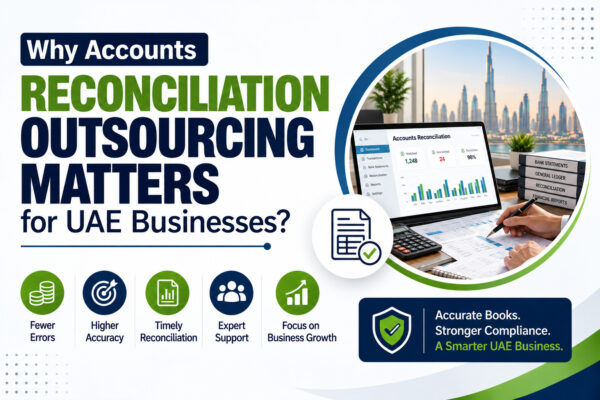
This is where accounts reconciliation outsourcing in the UAE becomes valuable.
By outsourcing reconciliation activities to an experienced accounting team, businesses can improve financial accuracy, identify discrepancies earlier, strengthen internal controls, and maintain more reliable financial reports.
What Is Accounts Reconciliation?
Accounts reconciliation is the process of comparing two sets of financial records to verify that transactions and balances are accurate, complete, and consistent.
The objective is to identify differences, investigate their causes, and make appropriate accounting corrections.
For example, a company’s accounting software may show a bank balance of AED 250,000, while its bank statement shows AED 245,000.
The AED 5,000 difference could result from outstanding payments, unrecorded bank charges, deposits in transit, duplicate entries, or other transactions requiring investigation.
Reconciliation helps explain these differences and ensures that the accounting records reflect the correct financial position.
Common Types of Accounts Reconciliation
- Bank Reconciliation: Comparing bank statements with cash and bank ledgers to identify missing or incorrectly recorded transactions.
- Accounts Receivable Reconciliation: Matching customer invoices, receipts, credit notes, and outstanding balances.
- Accounts Payable Reconciliation: Comparing supplier invoices, payments, credit notes, and supplier statements with accounting records.
- General Ledger Reconciliation: Reviewing ledger account balances against supporting schedules and transaction records.
- Credit Card Reconciliation: Matching credit card statements with recorded purchases, charges, refunds, and payments.
- Intercompany Reconciliation: Comparing transactions and balances between related companies to identify mismatches.
- Payroll Reconciliation: Comparing payroll summaries, salary liabilities, payroll journals, and payment records.
- VAT Account Reconciliation: Comparing VAT-related ledger balances with transaction reports and supporting schedules.
Each reconciliation contributes to the accuracy and completeness of financial information.
Why Is Accounts Reconciliation Important for UAE Businesses?
Businesses in the UAE operate in an environment where reliable financial records support everyday management decisions as well as applicable tax and reporting requirements.
Whether a company operates in Dubai, Abu Dhabi, Sharjah, or another emirate, unresolved accounting differences can create financial uncertainty.
Here are some common reasons reconciliation is particularly important.
- Increasing Transaction Volumes
As businesses expand, the number of sales invoices, supplier bills, bank transfers, credit card payments, and customer receipts generally increases.
Manually tracking these transactions becomes more difficult, particularly when a company operates multiple bank accounts or payment channels.
Without regular reconciliation, differences can accumulate and become harder to investigate.
- VAT and Corporate Tax Recordkeeping
UAE businesses must maintain appropriate accounting records to support their applicable VAT and Corporate Tax obligations.
Unreconciled balances, incorrectly recorded invoices, and missing transactions can affect the reliability of the underlying financial information used for tax reporting.
Regular reconciliation helps businesses identify accounting differences before they affect reporting and tax preparation.
- Need for Reliable Financial Reporting
Management decisions depend on accurate financial statements.
If bank balances, outstanding liabilities, or customer receivables are incorrect, financial reports may present a misleading picture of the business.
Reconciliation helps ensure that financial information is supported by reliable transaction records.
- Growing Need for Financial Control
Weak reconciliation procedures can allow duplicate transactions, unexplained payments, and longstanding accounting differences to remain undetected.
Regular reconciliation introduces an important financial control by ensuring recorded balances are periodically verified against independent or supporting information.
8 Benefits of Outsourcing Accounts Reconciliation in the UAE
- Improved Financial Accuracy
Even a small accounting error can affect several financial reports.
For example, recording a supplier payment twice may understate the bank ledger balance and reduce the accounts payable balance incorrectly.
Outsourced reconciliation teams systematically compare records to identify these differences.
How it helps:
- Detects duplicate or missing transactions.
- Identifies incorrect payment allocations.
- Highlights unexplained ledger balances.
- Supports accurate accounting adjustments.
- Improves the reliability of financial statements.
Regular reviews help prevent unresolved differences from accumulating over several accounting periods.
- Faster Identification of Accounting Discrepancies
When businesses reconcile accounts only at year-end, investigating discrepancies can become complicated.
Supporting documents may be difficult to locate, and employees may not remember the circumstances surrounding older transactions.
Outsourcing can establish a defined reconciliation schedule so discrepancies are investigated closer to the transaction date.
For example, an unmatched customer receipt identified during the current month is generally easier to resolve than one discovered nine months later.
The earlier a difference is identified, the easier it is to investigate and correct.
- Better Cash Flow Visibility
Cash flow management depends on accurate information about available funds, expected receipts, and upcoming payments.
If bank accounts and customer balances are not reconciled, management may rely on incomplete information.
Outsourced accounts reconciliation helps maintain dependable records of cash movements.
This supports:
- More accurate bank balances.
- Improved tracking of customer receipts.
- Better visibility over outstanding supplier payments.
- Identification of unrecorded bank charges.
- More reliable cash flow planning.
Accurate reconciliation does not automatically improve cash flow, but it provides better information for managing it.
- Stronger Financial Controls
Reconciliation is an important component of internal financial control.
It helps identify transactions that do not match expected records and balances requiring further investigation.
Outsourced reconciliation processes can include documented review procedures, discrepancy reports, and supporting schedules.
For example, a reconciliation team may identify an unexplained supplier payment and report it to authorised management for investigation.
However, outsourcing should be supported by appropriate segregation of duties.
Ideally, the person reviewing reconciliations should be independent of the person authorising payments.
This helps maintain oversight and reduces the risk of errors or unauthorised transactions remaining undetected.
- Reduced Workload for Internal Finance Teams
In many SMEs, internal accountants manage bookkeeping, invoicing, vendor payments, tax-related accounting, and management reporting.
Reconciling multiple accounts can consume significant time, particularly when transaction volumes are high.
By outsourcing repetitive reconciliation activities, internal finance teams can spend more time on:
- Budgeting and forecasting.
- Cash flow planning.
- Financial analysis.
- Management reporting.
- Cost and profitability reviews.
- Business planning.
The value of outsourcing lies not only in reducing routine accounting work but also in allowing internal finance resources to focus on higher-value activities.
- Timely Month-End Closing
Month-end reporting often gets delayed because outstanding reconciliations have not been completed.
Unmatched customer receipts, unexplained supplier balances, and unreconciled bank accounts can prevent finance teams from finalising financial statements.
Outsourced reconciliation services can help establish a consistent monthly closing schedule.
The process may include:
- Reconciling bank accounts.
- Reviewing receivable and payable balances.
- Checking general ledger accounts.
- Identifying required adjustments.
- Preparing reconciliation schedules.
- Reporting unresolved differences.
This improves the readiness of financial records for monthly management reporting.
- Better Audit and Tax Readiness
Businesses often experience additional accounting pressure when preparing for financial audits, tax reviews, or year-end closing.
If reconciliations have not been maintained regularly, the finance team may need to investigate historical differences and reconstruct supporting schedules.
Outsourced reconciliation helps maintain a clearer audit trail by linking accounting balances to relevant documents.
For UAE businesses, this can support preparation of information relevant to VAT and Corporate Tax obligations.
Regular reconciliations also help auditors and tax professionals review the underlying financial records more efficiently.
- Scalable Reconciliation Support
As a company grows, it may open additional bank accounts, expand payment channels, establish new branches, or increase customer and supplier transactions.
Its reconciliation workload can increase significantly.
Outsourced reconciliation services can be scaled based on the number of accounts, transaction volumes, and reporting requirements.
For example, a growing trading company may initially outsource only bank reconciliation.
Later, it may extend the arrangement to customer accounts, supplier statements, intercompany balances, and general ledger reviews.
This flexibility can help businesses manage accounting workloads without immediately expanding their internal finance teams.
Common Accounts Reconciliation Problems Faced by UAE Businesses
Reconciliation problems often develop gradually.
A business may continue recording transactions without noticing that certain balances are no longer accurate.
Some common issues include:
| Reconciliation Problem | Potential Business Impact |
| Unreconciled bank transactions | Incorrect cash balances |
| Customer receipts not allocated | Overstated outstanding receivables |
| Duplicate supplier payments | Financial losses and incorrect balances |
| Missing bank charges | Understated expenses |
| Incorrect supplier balances | Unreliable payment obligations |
| Unmatched intercompany balances | Differences in group financial records |
| Incorrect VAT ledger postings | Inaccurate VAT-related accounting information |
| Old unreconciled transactions | Delayed financial closing and additional investigation |
These problems highlight why reconciliation should be performed consistently rather than only when financial statements are due.
Practical Example: How Outsourced Reconciliation Helps a UAE Business
Consider a hypothetical Dubai-based trading company processing approximately 600 transactions each month.
The company receives customer payments through bank transfers and multiple payment channels.
Its finance team records transactions regularly, but bank reconciliations and customer account reviews are often delayed.
During the month-end closing process, the team discovers:
- AED 45,000 in customer receipts that have not been matched against invoices.
- AED 12,000 in supplier payments incorrectly recorded twice.
- AED 3,500 in bank charges missing from the general ledger.
These differences create uncertainty over cash balances, receivables, payables, and operating expenses.
The company decides to outsource its regular reconciliation activities.
The outsourced accounting team reviews bank statements, matches customer receipts, compares supplier payments, and prepares reconciliation reports.
After the discrepancies are investigated and authorised corrections are recorded, the company has more reliable financial balances.
Management can now review customer collections, supplier obligations, and cash positions with greater confidence.
The key benefit is not merely correcting individual accounting entries.
It is establishing a process that identifies financial differences before they become larger reporting problems.
How the Outsourced Accounts Reconciliation Process Works?
An effective outsourced reconciliation arrangement follows a structured process that provides clarity over responsibilities and reporting.
Step 1: Review Existing Accounting Records
The service provider reviews the chart of accounts, accounting software, bank accounts, and existing reconciliation procedures.
The objective is to understand the business’s transaction flow and identify accounts requiring regular reconciliation.
Step 2: Collect Financial Statements and Supporting Documents
Relevant information is obtained from the company, including:
- Bank and credit card statements.
- General ledger reports.
- Customer and supplier statements.
- Invoice and payment records.
- Payroll summaries.
- Existing reconciliation schedules.
Secure document-sharing procedures and appropriate accounting system access should be established.
Step 3: Match and Verify Transactions
Accounting records are compared against supporting statements and documents.
Matching transactions are verified, while exceptions are identified for further investigation.
Step 4: Investigate Differences
The reconciliation team reviews unmatched transactions, missing entries, incorrect allocations, and unexplained balances.
Where additional information is required, the team raises queries with the client.
Step 5: Prepare Reconciliation Adjustments
Once differences are understood, the team prepares appropriate correcting entries or recommendations.
Material adjustments should be reviewed and approved by authorised personnel before posting.
Step 6: Prepare Reconciliation Reports
The outsourced team provides reconciliation schedules showing:
- Reconciled balances.
- Identified differences.
- Proposed or completed adjustments.
- Outstanding transactions.
- Items requiring management action.
These schedules support financial closing, management reporting, and future reviews.
Accounts Reconciliation and UAE VAT and Corporate Tax Compliance
Reconciliation is particularly important when businesses need reliable accounting information for tax reporting.
VAT Reconciliation
For VAT-registered businesses, differences between accounting records and transaction reports may create issues when preparing VAT returns.
VAT-related reconciliation may include:
- Comparing output VAT ledger balances with sales reports.
- Comparing input VAT records with purchase transactions.
- Reviewing VAT credit notes and adjustments.
- Investigating differences between VAT control accounts and supporting schedules.
- Identifying transactions requiring further tax classification review.
UAE VAT-registered businesses are generally required to retain relevant records for a minimum of five years, although longer or extended retention periods apply in certain circumstances.
Regular reconciliation helps maintain a consistent connection between accounting entries and source documents.
Corporate Tax Reconciliation
Under the UAE Corporate Tax framework, accounting income generally forms the starting point for taxable income calculations, subject to adjustments required by tax legislation.
Accurate account balances are therefore important when preparing financial statements and supporting tax computations.
Relevant reconciliations may cover:
- Revenue accounts.
- Operating expenses.
- Fixed assets.
- Accrued expenses and other liabilities.
- Loans and related balances.
- Intercompany accounts.
UAE Corporate Tax records generally must be retained for seven years following the end of the applicable Tax Period.
Important: Accounts reconciliation supports reliable financial records and tax readiness. It does not replace specialist tax review, tax calculations, or statutory filing responsibilities.
When Should a UAE Business Outsource Accounts Reconciliation?
Outsourcing may be appropriate when a business regularly experiences any of the following situations:
- Bank reconciliations are delayed or incomplete.
- Customer and supplier balances contain unexplained differences.
- The finance team spends excessive time matching transactions.
- Month-end financial reporting is consistently delayed.
- The business operates multiple bank accounts or payment channels.
- Historical accounting discrepancies have accumulated.
- Auditors frequently request missing reconciliation schedules.
- Management lacks confidence in reported cash or liability balances.
Businesses facing these issues may benefit from external reconciliation support that introduces more consistent procedures and regular reporting.
Outsourced vs In-House Accounts Reconciliation
Both outsourced and in-house reconciliation can be effective when supported by appropriate processes and review controls.
| Factor | In-House Reconciliation | Outsourced Reconciliation |
| Staffing | Managed by internal employees | Managed by an external accounting team |
| Workload | Competes with other finance responsibilities | Dedicated agreed reconciliation activities |
| Scalability | May require additional staffing | Scope can be expanded |
| Reporting | Depends on internal resources | Based on agreed deliverables |
| Process consistency | Depends on internal procedures | Can follow documented service procedures |
| Oversight | Managed internally | Requires client review and approval |
| Cost structure | Employee and overhead costs | Contracted service fees |
For UAE SMEs with limited finance resources, outsourcing may provide a practical method of maintaining regular reconciliations.
Companies with complex operations may adopt a hybrid arrangement where an internal finance manager supervises outsourced reconciliation activities.
How to Choose the Right Accounts Reconciliation Outsourcing Partner in the UAE?
Before outsourcing reconciliation activities, businesses should evaluate the provider’s experience, processes, communication standards, and ability to maintain financial confidentiality.
Consider the following factors:
Accounting Experience: Confirm the provider understands bank, customer, supplier, general ledger, and other reconciliation requirements relevant to your business.
Software Compatibility: Check whether the provider can work with your existing accounting platform.
Review Procedures: Understand how reconciliation differences are identified, investigated, documented, and reported.
Reporting Timelines: Agree on the frequency of reconciliation and the deadlines for submitting reports.
Data Security: Confirm appropriate access permissions, secure document handling, and confidentiality arrangements.
Clear Responsibilities: Establish who prepares reconciliations, who approves adjustments, and who is responsible for resolving outstanding queries.
The right outsourcing arrangement should improve financial visibility while preserving management’s control over financial decisions.
How A2R Info Solutions Supports UAE Businesses?
At A2R Info Solutions, we understand that accurate accounting records begin with reliable reconciliation processes.
We provide outsourced accounts reconciliation and accounting support to help businesses across the UAE maintain organised financial records, identify discrepancies, and improve reporting accuracy.
Our services include:
Bank Reconciliation: Matching bank statements with accounting records and identifying outstanding or incorrectly recorded transactions.
Accounts Receivable Reconciliation: Reviewing customer invoices, payments, credit notes, and outstanding receivable balances.
Accounts Payable Reconciliation: Comparing supplier statements, invoices, payments, and outstanding liabilities.
General Ledger Reconciliation: Reviewing ledger balances and matching them with relevant supporting schedules.
Credit Card Reconciliation: Matching card transactions, charges, refunds, and payments with accounting records.
Intercompany Reconciliation: Identifying and investigating differences between related company accounts.
Historical Reconciliation and Catch-Up Support: Reviewing older transactions and resolving accumulated accounting discrepancies.
Reconciliation Reporting: Preparing reconciliation summaries and highlighting unresolved differences for management review.
Our team works with accounting platforms including QuickBooks, Xero, Zoho Books, Tally, and other commonly used accounting systems.
We focus on structured processes, clear communication, and consistent accounting support that helps businesses maintain reliable financial information.
Conclusion
Accounts reconciliation is a fundamental part of maintaining accurate financial records and effective financial control.
When bank accounts, customer balances, supplier liabilities, and general ledger accounts remain unreconciled, businesses risk making decisions using incomplete or incorrect financial information.
Accounts reconciliation outsourcing in the UAE offers businesses a practical way to manage reconciliation workloads, identify discrepancies earlier, improve reporting accuracy, and support financial recordkeeping.
For growing companies, the benefits extend beyond cleaner accounting records.
Reliable reconciliation supports more effective cash flow management, timely reporting, stronger internal controls, and greater confidence in financial decisions.
Improve Your Financial Accuracy with A2R Info Solutions
Are unreconciled transactions, incorrect ledger balances, or delayed month-end closings affecting your business?
A2R Info Solutions provides outsourced accounts reconciliation services to help UAE businesses maintain accurate records and streamline accounting operations.
Contact A2R Info Solutions to discuss how our reconciliation support can help improve the reliability of your financial information.