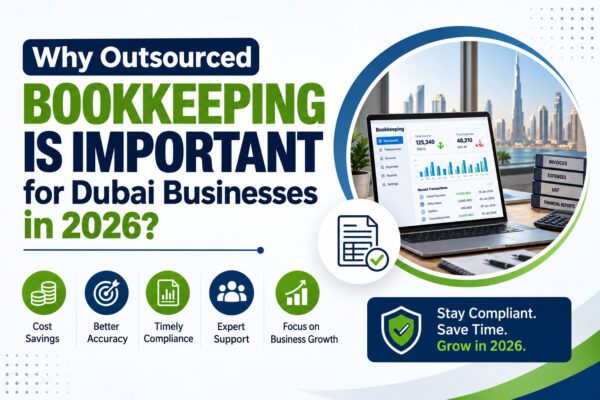
Running a business in the UAE involves more than generating revenue, managing clients, and expanding operations. Behind every successful business is a financial system that accurately records transactions, tracks cash flow, monitors expenses, and provides management with reliable information.
But what happens when your financial records are incomplete, bank reconciliations are delayed, or invoices are recorded incorrectly?
A business might appear profitable on paper while facing cash flow shortages. Outstanding customer payments may go unnoticed, expenses may be incorrectly classified, and management may make decisions based on outdated financial reports.
This is where outsourced bookkeeping services in the UAE can make a significant difference.
By introducing structured bookkeeping processes, regular reconciliations, and consistent financial reporting, outsourced bookkeeping helps businesses improve financial accuracy, strengthen internal controls, and gain better visibility over their operations.
Why Financial Accuracy and Control Matter for UAE Businesses?
Financial accuracy means that business transactions are recorded completely, correctly, and in the appropriate accounting period.
Financial control refers to the processes and checks that protect financial information, reduce errors, monitor transactions, and help prevent unauthorized activities.
Both are essential for businesses operating in the UAE.
Inaccurate bookkeeping can create several problems:
- Incorrect profit and loss statements that misrepresent business performance.
- Unreconciled bank accounts that conceal missing or duplicated transactions.
- Overdue customer invoices that affect cash flow.
- Incorrect expense classifications that distort profitability.
- Incomplete accounting records that complicate VAT and Corporate Tax compliance.
- Delayed financial reports that limit management’s ability to respond to problems.
For growing businesses, these issues can become more difficult to manage as transaction volumes increase.
A structured bookkeeping function helps ensure financial information remains reliable, organised, and available when management needs it.
How Outsourced Bookkeeping Services Improve Financial Accuracy
Outsourced bookkeeping is not simply about recording invoices and expenses. An effective bookkeeping process introduces consistency, verification, and regular financial reviews.
Here are some of the important ways outsourced bookkeeping improves financial accuracy.
- Accurate and Consistent Transaction Recording
Every business transaction affects financial reporting.
Whether it involves a supplier invoice, customer receipt, employee reimbursement, or operating expense, incorrect recording can affect the reliability of the accounts.
Outsourced bookkeeping teams follow defined accounting procedures to record transactions consistently.
How this improves accuracy:
- Records income and expenses under appropriate ledger accounts.
- Helps identify missing, duplicate, or incorrectly entered transactions.
- Ensures transactions are supported by relevant documents.
- Applies consistent accounting classifications.
- Supports appropriate cut-off and accrual adjustments.
Consistent transaction recording improves the quality of financial statements and reduces the corrections required during month-end closing.
- Regular Bank and Credit Card Reconciliation
One of the most common bookkeeping problems businesses experience is the difference between their accounting records and actual bank balances.
These differences may arise because of unrecorded charges, duplicate entries, missing receipts, timing differences, or incorrectly matched payments.
Outsourced bookkeeping services introduce regular bank and credit card reconciliation procedures.
How this improves accuracy:
- Matches accounting entries against bank statements.
- Identifies missing or duplicate transactions.
- Detects unrecorded bank fees and charges.
- Helps investigate unexplained differences.
- Keeps cash and bank balances more reliable.
Regular reconciliation also strengthens financial control by ensuring discrepancies are identified and investigated rather than carried forward indefinitely.
- Better Accounts Payable and Receivable Management
A business can generate significant revenue and still experience cash flow problems if customer payments are not tracked properly.
Similarly, poor supplier invoice management can result in duplicate payments, missed due dates, or inaccurate outstanding liability balances.
Outsourced bookkeeping improves visibility over both accounts payable and accounts receivable.
For accounts receivable:
- Records customer invoices and receipts.
- Matches customer payments against outstanding invoices.
- Maintains customer ageing reports.
- Identifies overdue receivables for follow-up.
- Helps reconcile customer account balances.
For accounts payable:
- Records and verifies supplier invoices.
- Tracks outstanding supplier balances.
- Maintains accounts payable ageing reports.
- Identifies potential duplicate invoices.
- Supports payment scheduling and reconciliation.
With accurate receivable and payable records, management can better understand what the business owes, what customers owe the business, and when cash inflows and outflows are expected.
- Timely Month-End Closing and Financial Reporting
When bookkeeping is postponed until the end of a quarter or financial year, errors accumulate and financial reports become less useful.
A structured outsourced bookkeeping arrangement can establish a regular month-end closing process.
This may include:
- Completing transaction entries.
- Reconciling bank and credit card accounts.
- Reviewing customer and supplier balances.
- Recording accruals and prepaid expenses.
- Reviewing outstanding liabilities.
- Preparing management financial reports.
Why it matters: Timely reporting gives business owners a clearer picture of profitability, operating expenses, financial position, and cash flow.
Instead of discovering financial problems months later, management can identify unusual balances and changes in performance earlier.
- Improved Expense Classification and Profitability Tracking
Not all business expenses should be treated the same way.
For example, recording a capital asset purchase as a routine operating expense can distort reported profitability and asset balances.
Similarly, allocating expenses to incorrect projects or departments can produce misleading financial results.
Outsourced bookkeeping teams can help maintain a structured chart of accounts and consistent expense classification.
This improves:
- Visibility over operating and administrative expenses.
- Tracking of department or project costs.
- Comparisons between budgeted and actual expenses.
- Identification of unusual cost increases.
- Reliability of financial performance reporting.
Businesses can then evaluate profitability using financial information that better reflects actual operations.
How Outsourced Bookkeeping Strengthens Financial Control?
Accurate financial records are important, but businesses also need systems that protect those records and reduce the risk of financial irregularities.
Professional outsourced bookkeeping services can support stronger financial controls through documented procedures and consistent monitoring.
- Defined Bookkeeping Processes
A documented bookkeeping process establishes how transactions should be received, verified, classified, recorded, and reconciled.
This reduces dependence on individual employees and supports consistency when transaction volumes increase.
- Clear Approval and Verification Procedures
A well-designed bookkeeping workflow separates transaction processing from payment authorisation.
For example, a bookkeeping team may prepare and verify supplier invoices, while authorised company personnel approve payments.
This helps reduce the risk of unauthorised or duplicate payments.
Importantly, outsourcing does not automatically create segregation of duties. Businesses must still establish appropriate approval rights, access restrictions, and independent review procedures.
- Better Supporting Documentation
Accurate bookkeeping depends on reliable source documents.
Invoices, receipts, contracts, bank statements, and payment confirmations should be organised and linked to relevant accounting entries.
This creates a clearer audit trail and makes financial transactions easier to verify.
- Regular Review of Unusual Transactions
Outsourced bookkeeping teams can help identify unusual ledger balances, duplicate entries, old outstanding amounts, and unreconciled transactions.
Regular exception reporting allows management to review these items and take corrective action.
- Controlled Access to Accounting Systems
Cloud accounting platforms such as QuickBooks, Xero, Zoho Books, and other accounting systems can support role-based access permissions and transaction histories, depending on the software and subscription.
Businesses can assign appropriate access rights to bookkeeping personnel while retaining control over sensitive functions such as payment approvals and administrator permissions.
The Role of Outsourced Bookkeeping in UAE VAT and Corporate Tax Readiness
Businesses operating in the UAE must maintain appropriate accounting records to support their applicable tax obligations.
Reliable bookkeeping provides the financial information needed for tax calculations, supporting schedules, reconciliations, and documentation.
Supporting VAT Recordkeeping
For businesses registered for UAE VAT, accurate bookkeeping helps maintain:
- Sales invoices and purchase invoices.
- Records of taxable, zero-rated, and exempt supplies.
- Appropriate input and output VAT accounting records.
- Credit notes and relevant adjustments.
- Reconciliations between VAT records and accounting ledgers.
- Supporting documentation for VAT return preparation.
The UAE Federal Tax Authority generally requires taxable persons to retain VAT invoices for at least five years, subject to applicable exceptions and extended retention requirements.
Supporting Corporate Tax Recordkeeping
For UAE Corporate Tax, financial accounting information is particularly important because accounting income is generally the starting point for calculating taxable income, subject to adjustments under the applicable Corporate Tax rules.
Accurate bookkeeping helps businesses maintain:
- Reliable income and expense records.
- Supporting documentation for transactions.
- Fixed asset and depreciation schedules.
- Records of relevant balances and adjustments.
- Financial information required for tax computations and reporting.
The UAE Corporate Tax framework generally requires Taxable Persons and Exempt Persons to retain relevant records for seven years following the end of the applicable Tax Period.
Important: Outsourced bookkeeping supports tax readiness, but VAT return filing, Corporate Tax calculations, and tax advisory services should be separately defined within the engagement scope.
Practical Example: How Outsourced Bookkeeping Can Improve Financial Visibility
Consider a hypothetical UAE trading company processing hundreds of customer and supplier transactions every month.
The company records invoices regularly but reconciles its bank accounts only at the end of each quarter.
Over time, several issues develop:
- Customer receipts remain unmatched against invoices.
- Supplier balances contain old or duplicate entries.
- Bank charges have not been recorded.
- Management reports are prepared using incomplete balances.
As a result, the finance team spends considerable time investigating differences instead of analysing business performance.
Now consider what changes when the company introduces a structured outsourced bookkeeping process.
The bookkeeping team records and reviews transactions regularly, reconciles bank accounts, matches customer receipts, checks supplier balances, and prepares monthly financial reports.
Management receives more reliable information about outstanding receivables, operating expenses, liabilities, and cash balances.
The value is not simply cleaner accounting records.
It is the ability to make financial decisions using more complete, timely, and dependable information.
Outsourced Bookkeeping vs In-House Bookkeeping in the UAE
Both models can provide accurate bookkeeping when supported by qualified personnel and appropriate controls. The main differences lie in resource allocation, operating flexibility, and management requirements.
| Area | In-House Bookkeeping | Outsourced Bookkeeping |
| Staffing | Requires internal hiring and supervision | External team manages agreed activities |
| Accounting processes | Developed and maintained internally | Can follow documented outsourced workflows |
| Scalability | May require additional recruitment | Service scope can be adjusted |
| Software | Managed by internal staff | Can work with existing accounting software |
| Financial reporting | Depends on internal capacity | Delivered according to agreed reporting timelines |
| Control | Direct internal oversight | Requires clear access, approvals, and service-level oversight |
For UAE SMEs without the need for a full-time internal bookkeeping department, outsourcing can provide a practical way to access structured accounting support.
However, businesses should evaluate service quality, data confidentiality, turnaround times, and responsibility allocation before selecting a provider.
When Should a UAE Business Consider Outsourcing Bookkeeping?
Businesses may benefit from outsourced bookkeeping when:
- Bank reconciliations are consistently delayed.
- Monthly financial reports are not available on time.
- Customer and supplier balances contain unexplained differences.
- Transaction volumes are growing faster than internal bookkeeping capacity.
- Management is spending excessive time correcting accounting entries.
- Financial records need to be organised before tax filings or audits.
- The business needs additional accounting support without expanding its permanent finance team.
Identifying these warning signs early can help businesses address accounting weaknesses before they create larger financial and operational problems.
How A2R Info Solutions Supports UAE Businesses?
At A2R Info Solutions, we provide outsourced bookkeeping and accounting support designed to help UAE businesses maintain organised financial records, improve transaction accuracy, and gain better visibility into their financial operations.
Our services include:
- Day-to-Day Bookkeeping: Recording and classifying financial transactions accurately and consistently.
- Bank and Credit Card Reconciliation: Matching accounting records with statements and identifying discrepancies.
- Accounts Payable and Receivable: Maintaining customer and supplier records, tracking outstanding balances, and supporting reconciliations.
- Monthly Financial Reporting: Preparing financial statements and management reports.
- Catch-Up Bookkeeping: Organising historical transactions, correcting accounting errors, and clearing unreconciled balances.
- VAT Accounting Support: Maintaining VAT-related accounting records and supporting schedules.
- Financial Reporting and MIS: Providing financial information that supports management reviews and business planning.
We work with accounting platforms including QuickBooks, Xero, Zoho Books, and other business accounting systems, helping clients maintain continuity with their existing processes.
Our objective is to help businesses move beyond routine transaction recording towards more reliable financial information and structured accounting operations.
Conclusion
Financial accuracy and control are essential for businesses that want to grow sustainably in the UAE.
When transactions are recorded incorrectly, reconciliations are delayed, or financial reports are incomplete, businesses face increased uncertainty over their financial position.
Outsourced bookkeeping services in the UAE can help address these challenges through consistent transaction recording, regular reconciliations, structured financial reporting, and stronger bookkeeping procedures.
The result is not just better-maintained books. It is clearer financial visibility, more reliable reporting, and improved support for management decisions.
Improve Your Financial Accuracy with A2R Info Solutions
Are incomplete financial records, delayed reconciliations, or inconsistent reporting affecting your business?
A2R Info Solutions helps UAE businesses maintain accurate accounting records and streamline bookkeeping processes through practical outsourced accounting support.
Explore Our Outsourced Bookkeeping Services and discover how structured bookkeeping can support your business.